


Twenty minutes is enough time to learn whether a city car fits your life, but only if you spend those minutes deliberately. Most test drives go wrong in the same way: the car is warm, the route is smooth, the salesperson is chatting, and you come back remembering the colour of the seats instead of the clutch. Treat the drive as a short exam. Here is a routine you can run in any small car, on almost any route, without annoying anyone.
Before You Start the Clock
Plan the route before you sit down. You want a tight side street, a stretch of broken tarmac or a couple of speed cushions, a junction where you have to look past parked cars, and somewhere legal and quiet to reverse. If your area has a hill, include it. Ask for the keys and go alone, or with one quiet passenger who will not narrate. In a used car, ask the seller to leave it cold so you can hear the first start.
Take your phone out and open a notes app. You will drive two or three cars this month and they will blur together by Sunday evening. Set a timer for twenty minutes. Four blocks of five minutes is plenty of structure.
Minutes 0–3: Fit Yourself to the Car
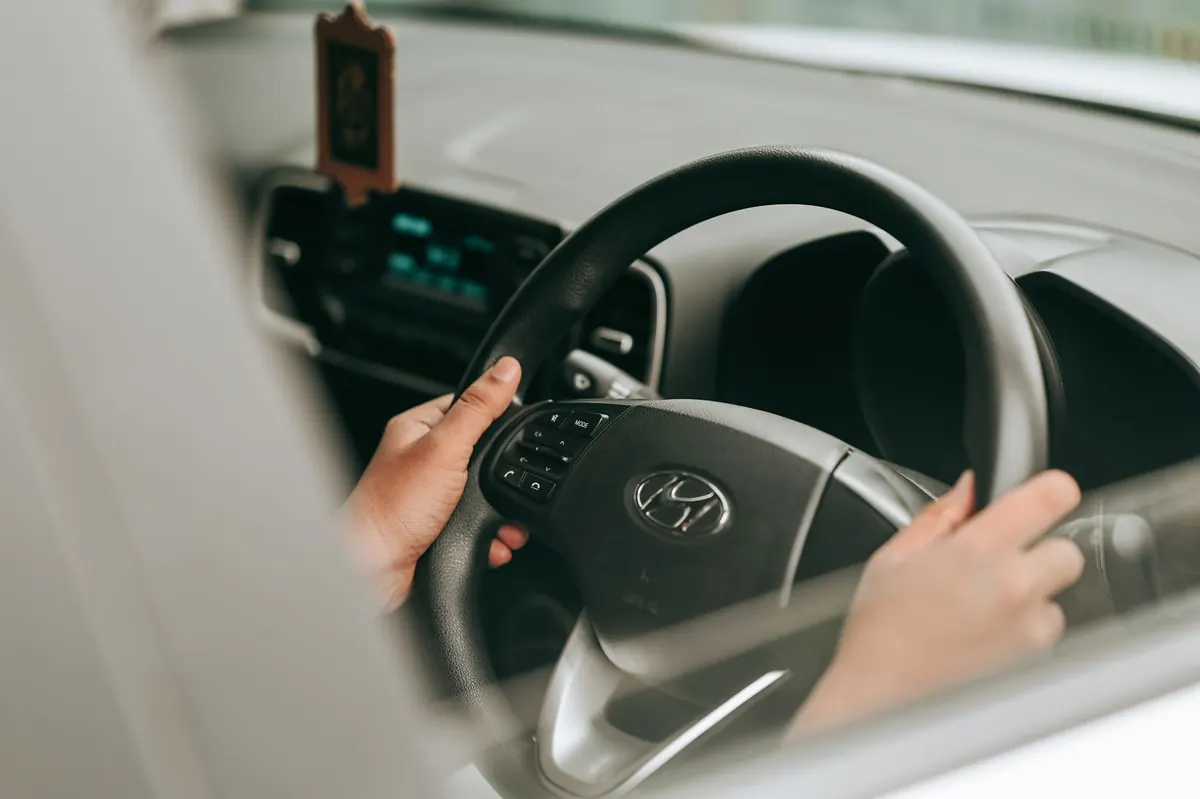
Adjust the seat height first. In a city car, a high hip point is the single biggest visibility upgrade you can buy, and it costs nothing. You should see over the bonnet and be able to rest your wrist on the top of the steering wheel with your shoulders against the backrest. Then the mirrors. Set the door mirrors so you can just catch the side of the car, and check that the interior mirror gives you a full view of the road behind rather than the rear headrests.
Press the clutch a few times if there is one. Find the dead pedal for your left foot and make sure your right knee is not jammed against the centre console. Check the small things while you are stationary: a door pocket that takes a water bottle, a cubby for a phone, a glovebox that closes with a satisfying thunk. You will touch these every day.
Minutes 3–7: Turning Circle, Low-Speed Steering and Visibility
In town, turning circle matters more than horsepower. Test it at the first safe chance — a wide, quiet road where you can swing the car around in one sweep, or a quiet car park where you can reverse into a bay. Count the shunts. A good small car will complete a U-turn in a single arc on most residential streets; a bad one will need three moves and a lot of faith.
Reverse into a space using the mirrors and a look over your shoulder, not just the camera. Can you judge the rear corners? Is there a bollard or a kerb you can see clearly? Then check the A-pillars at a junction. Lean forward slightly and see how much of a cyclist or a child at a crossing they hide. Thin pillars and a low window line make a real difference in traffic.
Minutes 7–12: Ride and Refinement on Real Roads
Now the part most drives skip. Take the car over the worst surface you can legally find: drain covers, patched tarmac, painted lines, speed cushions at a sensible speed. Short-wheelbase cars can crash and jiggle over ridges, and you will feel every one of them on a school run.
Listen as carefully as you feel. Small cars are not quiet cars, but the type of noise matters.
- A rattle from the dashboard, tailgate or parcel shelf over broken tarmac, which tends to get worse, not better.
- Tyre roar on coarse surfaces at 30–40 mph, which sets the tone for every motorway trip.
- A steady drone from the engine at a constant speed, which is what makes long drives tiring.
- Wind noise around the door mirrors and A-pillars, best checked above 50 mph if you get the chance.
If a car feels unsettled over rough ground at low speed, it will not improve at speed. Move on.
Minutes 12–15: Brakes and Bite
Start with the pedal while stationary: it should feel firm and consistent, not long and spongy. Then, on the move, creep up to a stop sign at walking pace. In a hybrid or electric car, this is where you feel the handover between regenerative braking and the friction brakes. A good car blends them invisibly. A clumsy one grabs or nods just before you stop, which you would notice every single day.
Find an empty, straight stretch and make one committed stop from about 30 mph. Feel for pulling to one side, vibration through the pedal, or a car that dives awkwardly. If there is a hill nearby, stop on it and pull away again, using the handbrake or the hill-hold function exactly as you would at home.
Minutes 15–18: Driving It Like a City Car
Pull out of a busy junction. If the car is automatic or has a dual-clutch gearbox, does it hesitate before it moves? That half-second gap is the difference between confidence and a near miss in traffic. In a manual, is the clutch light enough for a queue, and is the biting point easy to find?
Then trickle along at 15 mph and see whether the throttle is calm. You want to hold a steady speed without constant small corrections. Check how the car behaves at a mini-roundabout and whether you can see over parked cars at a T-junction. If the car has lane-keeping or automatic braking, notice whether it beeps and nudges when you do not want it to, and whether you can switch those systems off easily in the menus.
Minutes 18–20: Park It and Do a Lap
Hand back the keys only after a slow walk around the car. Will the boot take a weekly shop, or a folded pushchair? Is the load lip high? Do the doors open wide enough to load a child seat in a tight bay? Get in and out of the front and back seats twice. Then score what you found:
- Visibility: over your shoulder, at junctions, over parked cars
- Turning circle: how many shunts it took
- Ride: the worst surface you drove over
- Noise: tyre, wind and engine at your usual speeds
- Brakes: pedal feel and low-speed smoothness
- Comfort: seat, pedals, armrests, storage
- Traffic manners: pull-away, gearbox, throttle response
- Practicality: boot, doors, rear seats
After the Drive: Turning Notes into a Decision
Drive at least one rival in the same class on your own route before you commit. If anything felt off — a hesitation, a rattle, a seat that started to ache after ten minutes — go back and drive it again on a different day. Cold mornings, wet roads and your actual commute reveal things a warm demonstrator hides.
With a used car, a good drive does not replace paperwork. Check the service history and, if the drive raises mechanical questions, arrange an independent inspection before any money changes hands. For finance, insurance or warranty terms, speak to a qualified adviser rather than relying on the showroom's summary. And remember that a test drive that felt merely fine is not the same as a car that suits you. Twenty focused minutes will tell you which one you are sitting in.
Photo: Sachu Zayn / Pexels
Related posts
More stories you’ll love reading